
Platform / CoreFirst™ Scheduling

CoreFirst™ Scheduling — with Intelligent Workforce Tiering

Your most expensive clinician shouldn’t be the one you just met.

Core staff first. Float second. PRN and alumni third. Agency when — and only when — everyone else has declined.

Hospitals have already cut agency hard. The travel nurse market fell from $44.6 billion in 2022 to about $14 billion in 2025, and nearly three-quarters of hospitals plan to cut travel utilization further. The easy reductions are done. What is left is governance: making sure every open shift reaches your own people first, in a deliberate order, before it ever reaches the market. That is what CoreFirst™ Scheduling is built to do: shifts recommended from live demand, then filled in a deliberate order.

  1. Every open shift · in this order
  2. 1
    Core staffLowest cost · Highest continuity
  3. 2
    Float poolMulti-unit & multi-facility
  4. 3
    PRN · Per diem · AlumniFlexible · Pre-verified
  5. 4
    Agency · Travel · VMSHighest cost · Fully governed
  • Demand-Driven Scheduling
  • Census & Acuity Signals
  • Alumni Reengagement
  • Agency Governance
  • PRN Management
  • Credential-Aware Shift Broadcasting
  • Automated Tiering Rules
  • Internal Float Pool
  • Credential-Based Eligibility
  • Cost Optimization
The economics

Why the next dollar of agency savings is the hardest one.

$44.6B → $14.2BU.S. travel nurse market, 2022 peak to 2025 — a third consecutive year of contractionStaffing Industry Analysts
73.5%of hospitals project a further decrease in travel staff utilization — while still naming it a top strategy for covering shortagesNSI National Health Care Retention & RN Staffing Report, 2026
$91.23 vs. $59.46average hourly travel nurse fee against an employed RN — the gap is smaller than it was, and it is still every hourNSI, 2026
$60,090average cost to replace one staff RN, at a national turnover rate of 17.6%NSI, 2026

The rate-arbitrage argument has been run. Systems cut travel spend by roughly two-thirds between 2022 and 2025, and the remaining gap between a traveler and an employed nurse is closer to 1.5× than the 4× of the crisis years. Cutting harder is no longer the opportunity.

The opportunity is order. Most remaining agency spend is not a staffing decision — it is a visibility failure: an open shift goes to the market because no one could see, quickly enough, that a qualified nurse inside the network was available and willing. Every one of those shifts costs the premium twice. Once in the rate. Again in the continuity, because the most expensive clinician on your unit is the one who leaves — $60,090 to replace, at 17.6% turnover a year.

The CFO sees agency spend on every monthly report. The CHRO sees it in every workforce planning meeting. The CNO sees its consequences on every shift where a traveler arrives not knowing the unit, the team, or the workflow. Everyone sees the problem. Almost no one has the governance to solve it systematically. That is the gap CoreFirst™ is built to close.

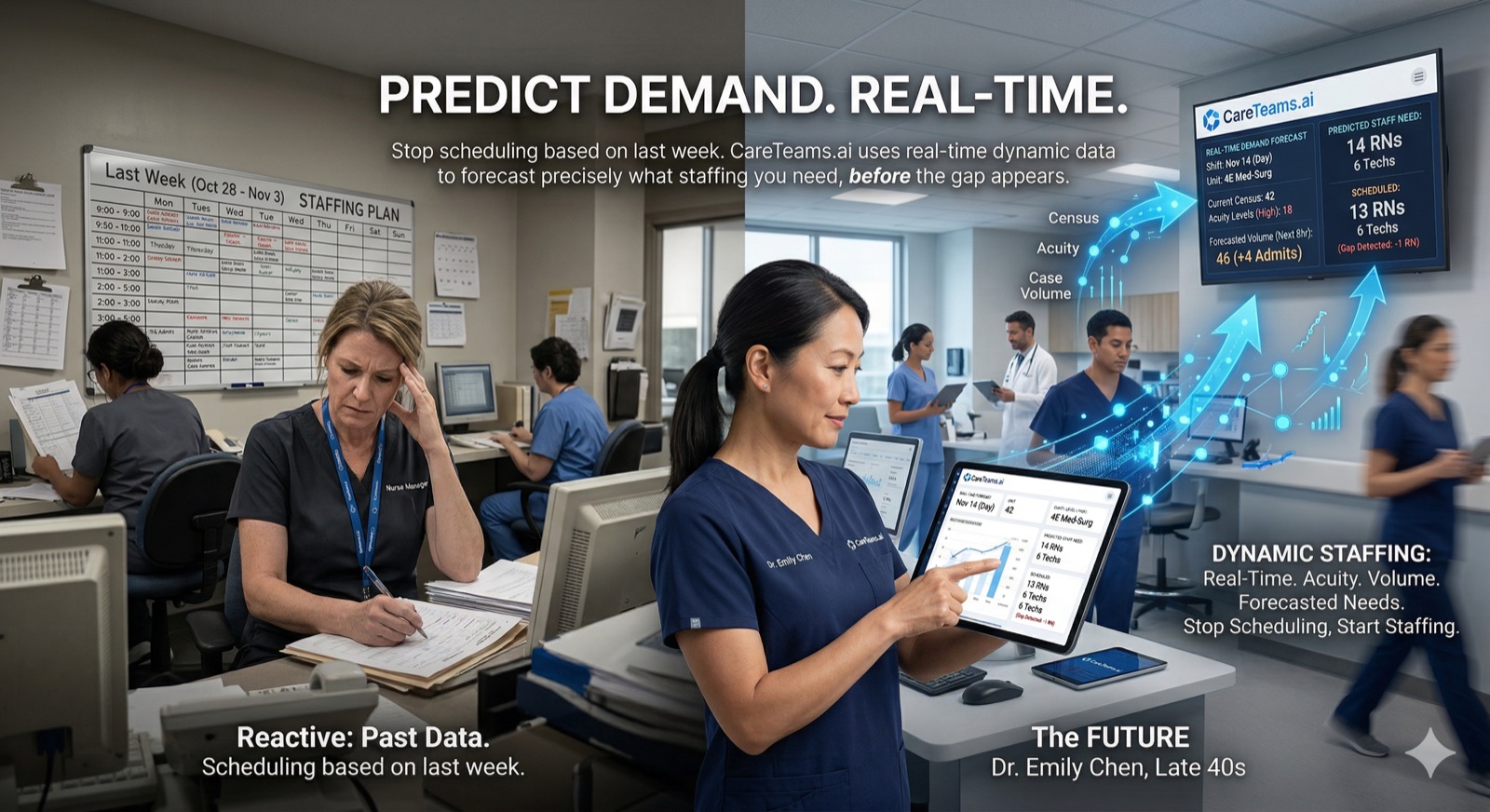
Reactive scheduling from last week’s data compared with demand forecasting driven by census, acuity and case volume
Step one: schedule to real demand

Scheduling built for what is coming, not what happened last week.

Demand-driven recommendations that read census, acuity and case volume, so the roster reflects the week you are actually about to have — and gaps surface early enough to fill them from inside.

When a gap does open, the four tiers below take over: invites go only to staff credentialed for the shift, in order, with overtime prevention built in.

  • Demand Forecasting
  • Census & Acuity Signals
  • Roster Building
  • Load Balancing
The four-tier governance model. Tech-enabled.

Every open shift broadcasts through a programmatic sequence.

Designed to minimize cost and maximize continuity of care. Each tier is fully configurable — you define the rules and the time windows, CoreFirst™ enforces them automatically.

  1. Tier1

    Core Staff

    Full-time employed clinicians with the right credentials and availability — first right of refusal on every open shift, at the best rate.

    Lowest cost · Highest continuity
  2. Tier2

    Float Pool

    Internal cross-trained staff credentialed across units and facilities in the network. Float differentials apply, and they deploy before any external resource.

    Multi-unit & multi-facility
  3. Tier3

    PRN | Per Diem | Alumni

    Pre-credentialed per diem and PRN staff, plus former employees who have opted back into the shift pool and still meet every qualification requirement. A higher rate, still internal — and still building engagement.

    Flexible · Pre-verified
  4. Tier4

    Agency | Travel | VMS

    External partners, engaged deliberately when internal tiers cannot meet the need — with the escalation, the rate, and the reason all on the record.

    Highest cost · Fully governed
Hidden capacity

Alumni reengagement — the workforce you already trained, quietly available again.

Most workforce systems treat former employees as deleted records. CoreFirst™ treats them as a tier.

Reachable through simplified re-onboarding when they are available, and excluded from broadcasts automatically when they are not. Retired nurses, parents on extended leave, clinicians who left for travel contracts and miss the team: all of them are capacity you have already paid to train.

94.9% of hospital separations are voluntary — and the leading reasons are relocation, personal circumstances, scheduling conflict, career moves and retirement. Most departures are not exits from nursing. NSI National Health Care Retention & RN Staffing Report, 2026
What CoreFirst™ delivers

By the audience that matters to you.

For The CHRO

A workforce strategy that actually works

Contingent labor stopped being a side program years ago. CoreFirst™ treats it as a standing discipline rather than a monthly emergency.

  • Unified governance across core, float, PRN, alumni and agency — one system, one set of rules, one accountability model
  • Alumni reengagement running through the Mobilize™ channel clinicians already use
  • Cross-facility credentialing, so employed staff become usable across the network instead of locked to a single site
  • Workforce-mix reporting — internal against external labor by unit, facility and specialty

For The CFO

Agency spend as a managed line item, not a surprise

Agency labor is the largest preventable cost variance on most hospital P&Ls. CoreFirst™ turns it into a governed, forecastable spend category — with clear causality between the rules you set and the savings you realize.

  • Cost-of-next-tier visibility — every escalation shows the financial delta before it happens, not after
  • Configurable cost ceilings, above which escalation requires approval rather than automation
  • Overtime prevention built into the broadcast, so OT is not discovered at month-end when it is already sunk
  • Configurable time windows — how long to wait, and how many people to reach, before the next tier opens
For The CNO

Continuity of care, not a rotating cast of strangers

Every traveler on a unit is a clinician who does not yet know the team, the workflow, or the patients. CoreFirst™ keeps internal staff on your units more often and makes the traveler the exception rather than the default.

  • Faster fills — employed staff respond to a broadcast from their phone in seconds
  • Credentialed, familiar clinicians on more shifts, with no unit orientation and no ramp-up
  • Staffing mix visible by unit as it happens, not in a report three weeks later
  • Fewer departures to replace — at $60,090 each, continuity is a financial argument as much as a clinical one
The governance mechanics

How CoreFirst™ enforces the rules.

Credential-based eligibility

Only clinicians holding the exact credentials, specialty and facility badges the shift requires receive the broadcast. Nobody is offered a shift they are not qualified to work — a compliance win running in parallel.

Proximity-based filtering

Each clinician sets a travel radius; each facility has a location. Broadcasts match the two, so a float nurse in Sacramento is never offered a 4 AM shift in Modesto.

OT exposure exclusion

Staff approaching a configured overtime threshold drop out of the broadcast pool automatically. Overtime is prevented at the point of scheduling rather than reported at the end of the period.

Time-window escalation

Each tier has an acceptance window. If no qualified clinician accepts inside it, CoreFirst™ escalates to the next tier on its own — no human chase.

Shift incentive integration

Hard or short-notice shifts can carry a differential, recognition, or an AnyTime Pay™ bonus. Motivation science drives voluntary pickup, turning the shifts nobody wants into the ones worth taking.

VMS and agency integration

When Tier 4 is reached, the escalation is designed to pass cleanly to your existing VMS or agency partners, with the decision and its cost on the record. Agency is a partner, engaged intentionally.

What to measure

We would rather be judged on your numbers than quote someone else’s.

Four measures, baselined before go-live and tracked from day one:

  1. 01

    Internal fill rate

    The share of open shifts filled at Tiers 1–3, before agency is reached. The number the whole model exists to move.

  2. 02

    Agency hours as a share of clinical hours

    By unit, facility and specialty — the line the CFO already watches, finally attributable to a decision.

  3. 03

    Escalation rate by tier

    How often each tier fails to fill, and why. This is where the rules get tuned.

  4. 04

    Overtime hours avoided

    Hours that would have crossed a configured threshold and were routed elsewhere instead.

Illustration of clinicians moving between connected facilities in one health system network
Meet Maya — an illustrative example

A float nurse whose career just became a lot more flexible — and a lot more valuable.

Maya is a Med-Surg RN in Sacramento. Her health system has seven facilities within a 60-mile radius — three acute hospitals, two ambulatory surgery centers, two long-term care facilities. She is credentialed at exactly one of them. Every other site in her own network is, for practical purposes, a different employer: different badge, different onboarding, different systems, different way to ask for a day off.

Under CoreFirst™, Maya’s profile is credentialed, verified and active across all seven. When an ICU at Facility B is short tomorrow night, Mobilize™ sends her the broadcast — because her credentials match, her preferences allow overnight work, and Facility B sits inside her travel radius. She accepts with one tap and earns a facility differential.

Maya’s paycheck is bigger. The system pays an internal differential instead of an agency fee that averages $91 an hour nationally. The CNO gets a nurse who knows the network rather than a stranger. Nobody had to negotiate anything for that to happen — the order did the work.

Travel nurse fee: NSI National Health Care Retention & RN Staffing Report, 2026.

Agency isn’t the enemy.
Agency-as-default is.

See CoreFirst™ working across your facilities and your workforce.

No generic demo. A focused conversation about your agency spend, your float pool structure, your alumni population, and what governance looks like when it is built in rather than bolted on.